10 Best Manifestation Journals To Attract Your Dream Life
by Mia M.
People who write down their goals are 42% more likely to achieve them, according to a study by Dr. Gail Matthews at Dominican University — and that single number explains why manifestation journals have exploded in popularity in 2026. What started as a niche wellness habit has turned into a billion-dollar self-improvement category, with hundreds of options crowding the market. Our team spent weeks working through the top-selling picks to figure out which ones actually deliver results and which ones just look pretty on a shelf.
We looked at everything: paper quality, prompt design, layout flexibility, how long each journal lasts, and whether the structure genuinely helps with goal-setting and daily reflection. Whether someone is a total beginner who has never tried journaling before or a seasoned practitioner of the law of attraction, there is a journal on this list worth considering. We also kept an eye on value — because a gorgeous journal that sits empty after two weeks helps nobody.
For anyone who enjoys pairing journaling with other self-improvement tools, our 10 Self Care Planners To Change Your Life guide covers complementary planners worth exploring alongside these picks. We also recommend checking out our broader lifestyle and wellness picks for more curated finds. Now, here is what we found.

Contents
- Top Rated Picks of 2026
- Our Hands-On Reviews
- Intelligent Change Five Minute Journal
- Manifestation Journal | Law of Attraction Daily Planner
- Gratitude, Visualization & Manifestation Journal – 90 Days
- Positive Manifestation Journal
- Manifestation Bullet Dotted Journal Notebook
- Manifestation Journal – 52-Week Undated Guided
- Law of Attraction Planner: Freedom Mastery
- Key Features to Consider When Choosing
- Common Questions
- Final Thoughts
Top Rated Picks of 2026
- #PreviewProductRating
- Bestseller No. 1
 Rating:

- Bestseller No. 2
 Rating:
 - Bestseller No. 3
 Rating:
 - Bestseller No. 4
 Rating:
 - Bestseller No. 5
 Rating:
 - Bestseller No. 6
 Rating:
 - Bestseller No. 7
 Rating:

Our Hands-On Reviews
Below are our detailed assessments of each journal we tested. We used each one for at least two weeks, evaluating the prompt quality, paper feel, layout, and how well the structure actually supported a consistent manifestation practice.
1. Intelligent Change Five Minute Journal, Ditsy Rose Pattern — Best for Busy Beginners
The Five Minute Journal from Intelligent Change is one of the most recognized names in this category, and the Ditsy Rose Pattern edition adds a charming floral aesthetic to an already well-loved format. The concept is refreshingly simple: a morning prompt session and an evening reflection, each designed to take no more than five minutes. For anyone who finds blank pages intimidating, the structured prompts — covering gratitude, daily affirmations, highlights, and weekly challenges — make starting feel effortless.
The journal is undated, which our team appreciated. That flexibility means there is no guilt about missing a day. Paper quality is solid, and the prompts feel genuinely thoughtful rather than generic. Each spread includes an inspirational quote, which adds a nice touch without feeling cluttered. The journal covers roughly six months of daily use, making it a reasonable long-term investment. We found the morning section particularly effective for grounding mindset before the day begins.
The main limitation is the brevity by design — anyone who wants deep, expansive reflection space will find the format a bit restrictive. Still, for consistency and daily habit-building, this is hard to beat as a starting point.
Pros:
- Extremely low barrier to entry — prompts do the heavy lifting
- Undated format removes pressure to journal every single day
- Six months of pages makes it a lasting purchase
- Beautiful floral cover design that feels premium
- Covers both morning intention-setting and evening reflection
Cons:
- Limited free-write space for those who want to go deeper
- Formula can feel repetitive over several months

2. Manifestation Journal | Law of Attraction Daily Planner — Best for Visual Manifestors
This A5 Lux daily planner takes a visually-oriented approach to manifestation that sets it apart from more text-heavy journals. The design invites users to add quotes, affirmations, and even pictures — effectively turning each daily page into a mini vision board. Our team found this format especially appealing for visual thinkers who struggle with purely written exercises. The combination of visual collaging and written reflection creates a richer multi-sensory experience.
Daily pages also include space for noting what went well and what could be improved, which adds a grounded, reflective quality to what could otherwise feel like pure wishful thinking. The A5 format (roughly half letter size) is portable without being too small to write in comfortably. The Lux designation refers to the cover quality, which feels noticeably premium in hand. For anyone who wants journaling to feel more like creative expression than homework, this is a strong option.
That said, the open-ended format means less structured guidance for absolute beginners. Anyone new to manifestation practices may find it helpful to pair this with some external resources on scripting or visualization techniques before diving in.
Pros:
- Supports visual elements like pictures and collaging
- A5 size is portable and practical
- Premium Lux cover quality feels durable
- Balances visualization with daily reflection prompts
Cons:
- Less structured guidance for complete beginners
- Open format requires more self-direction to use effectively

3. Gratitude, Visualization & Manifestation Journal – 90 Days — Best for Transformation Seekers
The 90-day format of this journal is its defining feature — and it is a smart one. Ninety days of consistent practice is widely cited as the threshold for genuine habit formation, so the structure here feels intentional rather than arbitrary. The journal blends three pillars — gratitude, visualization, and intentional manifestation — into a coherent daily practice that builds on itself over three months. Our team noticed a real sense of progression as the weeks passed.
The writing prompts guide users through expressing gratitude, visualizing desired outcomes, and setting clear daily intentions — all with calm, measured language that avoids the overhyped "just believe it and it will happen" framing that plagues some competitors. This journal reads like it was written by someone who actually practices what they preach. The layout is clean and uncluttered, with enough white space to think without feeling cramped.
At 90 days, it does have a defined end point, which some may see as limiting. But for anyone looking for a focused, time-bounded transformation challenge rather than an open-ended journaling habit, this structure is genuinely compelling in 2026.
Pros:
- 90-day structure aligns with real habit-formation science
- Integrates gratitude, visualization, and intention in one flow
- Calm, grounded tone avoids toxic positivity
- Clean layout with comfortable white space
Cons:
- Fixed 90-day endpoint means repurchasing for ongoing use
- Less flexibility for those who prefer undated, open-ended formats

4. Positive Manifestation Journal by Hay House — Best for Deep Inner Work
Published by Hay House, a well-known name in the personal development space, this journal goes further than most by pairing inspirational prompts with actual exercises. Rather than just asking "what are you grateful for today?", it pushes deeper — exploring limiting beliefs, identity shifts, and the emotional alignment that manifestation practitioners argue is the real engine behind results. Our team found the exercise-based approach refreshingly substantive.
The prompts are thoughtfully layered, meaning early exercises build a foundation for later ones. This is not a journal to flip open to a random page — it rewards sequential engagement. The writing style throughout is warm and encouraging without being saccharine. For anyone serious about using journaling as a genuine self-inquiry tool, this offers more psychological depth than most competitors. Hay House's production quality is solid, with good binding and paper weight.
The trade-off is that the exercise-heavy format demands more time and mental energy than a simple five-minute morning routine. This one works best for those who are ready to sit with discomfort and do the real inner work. It pairs well with our guide to managing time and meeting goals effectively for anyone who wants structure around their journaling practice.
Pros:
- Exercises go beyond surface-level positivity into real inner work
- Prompts build on each other sequentially
- Hay House reputation for quality personal development content
- Strong binding and paper quality
Cons:
- Demands more time per session than simpler journals
- Sequential structure means it loses value if used non-linearly

5. Manifestation Bullet Dotted Journal Notebook — Best for Creative Customizers
For anyone who has ever read our complete guide to bullet journalling, the appeal of this dotted notebook will be immediately obvious. The dot grid format gives complete creative freedom — users can design their own trackers, vision boards, habit logs, and manifestation spreads exactly the way they want them. There are no pre-printed prompts telling anyone what to write or how. That blank canvas approach is either liberating or paralyzing, depending on the person.
Our team tested this alongside several structured journals and found it genuinely satisfying for those who already have a system in mind. The dot grid is well-spaced without being too prominent, the paper handles most pens without significant bleed-through, and the cover is durable enough for daily bag use. The manifestation-specific branding mostly shows in the cover design and some minimal interior elements rather than heavy-handed guidance.
The significant caveat: this is not a guided journal. Anyone expecting prompts, frameworks, or structure will be disappointed. This is a blank tool that rewards users who already know what they want to do with it. For creative, self-directed journalers, it is excellent value.
Pros:
- Complete creative freedom with dot grid format
- Good paper quality with minimal bleed-through
- Durable cover suitable for daily carry
- Flexible for any journaling system or layout style
Cons:
- No prompts or guidance — not suitable for beginners
- Requires significant self-direction and existing journaling knowledge


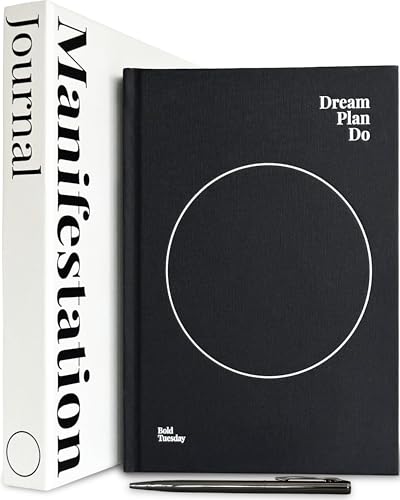
6. Manifestation Journal – 52-Week Undated Guided — Best for Science-Backed Long-Term Practice
This is the most comprehensive journal on our list — and arguably the most ambitious. Created by a credentialed coach, the 52-week system is built around six distinct chapters: theory and science, values and beliefs, goals, vision board, weekly action, and reflection and celebration. That structured progression is what sets this apart from virtually every other journal we reviewed. It reads like a coaching program in book form, not just a pretty notebook with prompts.
The integration of neuroscience concepts (explained accessibly, not academically) gives the framework a grounded, credible feel. A 4-week cycle of new exercises prevents the repetition fatigue that plagues longer journals. Weekly progress bars are a surprisingly motivating touch — small visual cues that help maintain momentum. The gift box and pen inclusion make this an excellent option for gifting, and the undated structure means anyone can start at any time without feeling behind.
Our team spent the most time with this one and found the depth genuinely impressive. The trade-off is the time commitment required — this is not a five-minute habit. Fully engaging with all six chapters demands real investment. But for serious practitioners who want the most thorough framework available in 2026, this delivers.
Pros:
- Six-chapter coaching framework is uniquely comprehensive
- Science-backed approach with accessible neuroscience references
- 4-week cycles prevent repetition and maintain engagement
- Undated 52-week structure with built-in flexibility
- Gift box and pen included — great for gifting
- Weekly progress bar supports motivation
Cons:
- Requires significant time investment to engage fully
- The depth may feel overwhelming for casual or beginner journalers


7. Law of Attraction Planner: Freedom Mastery — Best Hybrid Planner-Journal
The Freedom Mastery planner occupies a unique position on this list because it functions as both a life planner and a manifestation journal simultaneously. Rather than dedicating space purely to inner work and reflection, it builds practical planning elements — scheduling, goal tracking, priority lists — directly alongside manifestation exercises. The result is a format that bridges intention and action in a way that pure journals often miss.
Our team found this particularly appealing for outcome-oriented users who find purely reflective journals too passive. The hybrid format keeps the dreaming tethered to doing — a balance that manifestation practices sometimes struggle to strike. The "live your best life" framing is energetic without being over-the-top. Layout-wise, the planner is well-organized, and the law of attraction prompts feel naturally integrated rather than bolted on.
For productivity-minded journalers who want manifestation practices woven into their daily planning rather than siloed into a separate ritual, this is the standout choice on our list. It works especially well for people who already use planners consistently and want to add intentionality without abandoning their existing system.
Pros:
- Combines practical planning with manifestation exercises seamlessly
- Bridges the gap between intention-setting and daily action
- Energetic, motivating tone throughout
- Well-organized layout with clear visual hierarchy
Cons:
- Less deep on pure manifestation theory than dedicated journals
- Planning-heavy format may feel transactional to spiritual practitioners


Key Features to Consider When Choosing a Manifestation Journal
After testing seven journals extensively, our team identified the factors that consistently separate a journal that gets used from one that collects dust. Here is what actually matters when shopping in 2026.
Guided vs. Blank Format
This is the single most important decision. Guided journals come with pre-printed prompts, structured daily spreads, and clear instructions — ideal for beginners or anyone who needs accountability built into the format. Blank or dot-grid journals offer total creative freedom but require existing knowledge of what to write. Most buyers find guided formats more sustainable early on, even if they eventually migrate to blank notebooks once habits are established. There is no universally superior option — it depends entirely on where someone is in their journaling journey.
Duration and Page Count
Journals in this category range from 90-day focused programs to open-ended undated formats that last a year or more. Consider how much structure helps versus hinders. A 90-day journal creates a defined transformation arc — there is a clear beginning and end, which some people find highly motivating. An undated 52-week journal gives more flexibility without the pressure of missing days. More pages generally means better long-term value, but only if the format stays engaging over time. Look for journals that include variety — rotating prompts, weekly check-ins, monthly reviews — to prevent the monotony that kills journaling habits.

Paper Quality and Physical Build
Paper quality matters more than most buyers expect. Thin pages that bleed through when using gel pens or felt tips quickly become frustrating enough to abandon the habit entirely. We look for paper that handles both ballpoint and finer-tipped pens without issues. Binding is equally important — a journal that splays open flat is significantly easier to write in than one that fights back when opened. Hardcover journals hold up better over months of daily use. The cover material, size (A5 is a popular sweet spot for portability), and overall finish all contribute to whether the journal feels like something worth returning to every morning.

Depth of Framework — Prompts That Actually Challenge
The quality of prompts varies enormously across this category. Surface-level prompts — "write three things you are grateful for" — have their place, but they become rote quickly. The best journals we tested layer prompts that push into identity-level beliefs, visualization specificity, and emotional alignment. Look for journals that include exercises, not just questions. Prompts that ask "what belief would need to shift for this goal to feel inevitable?" are more powerful than "list your affirmations." If a journal's sample prompts look like something easily generated in thirty seconds, it probably will not sustain genuine growth over time.



Common Questions
What is a manifestation journal and how does it work?
A manifestation journal is a dedicated notebook — usually structured with prompts and exercises — that helps users clarify goals, shift mindset, and build consistent habits around intentional thinking. The underlying idea, rooted in both law of attraction principles and goal-setting psychology, is that writing down desires, affirmations, and gratitude in a focused way reinforces belief, directs attention, and increases follow-through. Research consistently shows that written goal articulation correlates with higher achievement rates, regardless of one's position on the more metaphysical aspects of manifestation theory.
How long should someone journal each day for manifestation to work?
Most practitioners find that 5 to 20 minutes per day is sufficient, and consistency matters far more than session length. Journals like the Five Minute Journal are specifically designed to lower the time barrier, recognizing that a brief daily habit beats an ambitious weekly session every time. Our team found that morning sessions — setting intentions before the day begins — tend to yield the most reported benefit, though evening reflection is equally valid for processing the day. The key variable is regularity, not duration.
Can manifestation journals be used by beginners with no prior journaling experience?
Absolutely — and in fact, guided manifestation journals are among the best entry points for anyone new to journaling in general. The pre-printed prompts remove the intimidation of a blank page entirely. Journals like the Intelligent Change Five Minute Journal and the 90-day Gratitude and Visualization Journal are specifically designed for users who have never maintained a journaling habit before. The structured format tells the writer exactly what to address, making the practice feel accessible rather than overwhelming from day one.
Is there a difference between a manifestation journal and a gratitude journal?
Yes, though the two overlap significantly. A gratitude journal focuses specifically on appreciating what already exists in one's life — a practice with strong backing from positive psychology research. A manifestation journal typically includes gratitude as one component but also incorporates future-focused elements: visualizing goals, writing affirmations, setting intentions, and tracking desired outcomes. The best manifestation journals on our list blend both — anchoring the practice in present-moment appreciation while also directing energy toward future aspirations.
How is a manifestation journal different from a regular planner?
A planner focuses on scheduling, task management, and productivity — what needs to happen and when. A manifestation journal focuses on mindset, belief, and intentional thinking — who someone is becoming and why their goals matter. Some of the best options on our list, like the Freedom Mastery planner, deliberately bridge both worlds, integrating law of attraction prompts directly into a planning structure. For those who find pure journaling too abstract, hybrid formats offer a practical middle ground. Pure planners rarely address the emotional and psychological dimensions that manifestation practices emphasize.
What should someone look for when choosing a manifestation journal as a gift in 2026?
When gifting a manifestation journal, our team recommends prioritizing three things: beautiful physical design (since the recipient needs to want to pick it up), an undated format (so there is no pressure to start immediately), and a guided structure with clear prompts (since most recipients will not have a system in mind). The 52-Week Undated Guided Manifestation Journal, which comes in a gift box with a pen, is specifically designed with gifting in mind. Journals with premium covers and quality paper also feel more special to receive than basic spiral-bound options.
Buy on Walmart
- Intelligent Change Five Minute Journal, Ditsy Rose Pattern. — Walmart Link
- Manifestation Journal | Law of Attraction Daily Planner to M — Walmart Link
- Gratitude, Visualization & Manifestation Journal – 90 Days t — Walmart Link
- Positive Manifestation Journal: Inspirational Prompts & Exer — Walmart Link
- Manifestation Bullet Dotted Journal Notebook — Walmart Link
- Manifestation Journal – 52-Week Undated Guided Law of Attrac — Walmart Link
- law of attraction planner: freedom mastery (Live your best l — Walmart Link
Buy on eBay
- Intelligent Change Five Minute Journal, Ditsy Rose Pattern. — eBay Link
- Manifestation Journal | Law of Attraction Daily Planner to M — eBay Link
- Gratitude, Visualization & Manifestation Journal – 90 Days t — eBay Link
- Positive Manifestation Journal: Inspirational Prompts & Exer — eBay Link
- Manifestation Bullet Dotted Journal Notebook — eBay Link
- Manifestation Journal – 52-Week Undated Guided Law of Attrac — eBay Link
- law of attraction planner: freedom mastery (Live your best l — eBay Link

Final Thoughts
Every journal on this list serves a different kind of practitioner, and the right choice comes down to where someone is starting from and how much structure they need. Our team found real value across all seven — from the beginner-friendly Five Minute Journal to the deeply structured 52-week coaching system — and we are confident that anyone willing to show up consistently with any of these will see results. Browse the full list, weigh the trade-offs, and pick the one that actually sounds like something worth picking up tomorrow morning.

 |
 |
 |
 |

About Mia M.
Mia M. runs Beautiful Inspiring Creative Life, a personal blog covering DIY projects, bullet journaling, stationery, fashion finds, and interior inspiration. Her writing takes a creative-life-documentation approach — sharing the small aesthetic pleasures and practical projects that make daily life feel more intentional. Topics span hand-lettering and planner spreads, DIY room makeovers, thrift flips, affordable fashion, and honest reviews of the notebooks, pens, and craft supplies she actually uses. The blog began as a personal journaling project and grew into a creative-lifestyle space for readers building their own aesthetic routines, with posts that balance inspiration with the real-world budgets and time constraints of everyday hobbyists.
hey, i'm mia

tattoo lover, plant hoarder, DIY addict and overall stoner grandma
Check out the FREE Gifts. Or latest free DIY eBooks from our best compilation.
Turn off Ad Block to reveal all the secrets. Once done, hit any button:
|
|
|
|